Blog ini mempamerkan maklumat kesihatan berkenaan rawatan terkini masalah-masalah sakitpuan, ketidaksuburan, endometriosis, PCOS dan lain-lain. Ia khas buat wanita yang mengalami gangguan kesihatan ataupun yang inginkan penerangan lanjut berkenaan penyakit wanita.

Friday, March 1, 2013

Questions About Robotic Hysterectomy


This is an article published recently about the use of the robot to do laparoscopic surgery. This is a growing trend among gynae surgeons and sometimes shows "macho". Although the surgery is very precise, it takes longer to set up and the cost is expensive. That is the main reason why I don't do it. The other issue addressed in this article is the removal of the uterus, or hysterectomy. More and more women are tending to keep their uteri and ovaries till late, and I encourage you to question your doctor strongly whether you really require one. Many doctors do this because sometimes it is easier to do than removing a growth.
Artikel ini berkenaan pembedahan laparoskopi dengan mengguna robot. Makin banyak pusat perubatan di negara barat mula mengawal cara ini, tetapi hanya 2 pusat di Malaysia. Walaupun pembedahan jenis ini lebih tepat, belanja menjalaninya lebih tinggi dan hasilnya hampir sama. Ini adalah sebab utama saya tidak mengamalinya. Selain dari ini, artikel ini juga menyentuh berkenaan pembuangan rahim, atau histerektomi. Trend zaman sekarang adalah untuk menyimpan rahim serta ovari kecuali betul-betul perlu dibuang. Jikalau anda berada dalam keadaan memerlukan pembedahan, pastikan dengan betul dan secara mendalam keperluan menjalani histerektomi. Ramai doktor melakukan histerektomi hanya kerana ia lebih senang dilakukan daripada membuang ketumbuhan.

FEBRUARY 25, 2013, 5:01 PM
in The New York Times
Ever since it was approved by the Food and Drug Administration in 2005, robotic surgery for hysterectomy has been heavily advertised. Surgeons promise that using the da Vinci robotic device will bring better results and an easier recovery, and many hospitals claim that patients will experience less pain and fewer complications, getting back on their feet faster.
The company that makes da Vinci robotic surgery equipment promoted it last May at free health workshops organized by the federal Office on Womens’ Health. On Sunday, the Liberty Science Museum in Jersey City will host its first “Let’s Operate Day,” offering guests “hands-on” practice peering into video monitors and using da Vinci’s robot arms to pick up and manipulate small objects.
The cost of the new technology is rarely mentioned. But last week, a new study that evaluated outcomes in more than a quarter of a million American women raised questions about the manufacturer’s claims. The paper, published in The Journal of the American Medical Association, compared outcomes in 264,758 women who had either laparoscopic or robotically assisted hysterectomy at 441 hospitals between 2007 and 2010. Both methods are minimally invasive and involve smaller incisions than open abdominal surgery.
The researchers found no overall difference in complication rates between the two groups, and no difference in the rates of blood transfusion, even though one of the claims regarding robotic surgery is that it causes less blood loss.
But the researchers did find a big difference in cost. Robotically assisted surgery for hysterectomy costs on average about one-third more than laparoscopic surgery.
“It’s important to separate the marketing from the data,” said Dr. Jason D. Wright, the study’s lead author, an assistant professor of obstetrics and gynecology at Columbia University Medical Center. “For the surgeon, there is a greater degree of movement and control of the instruments and the visualization is better.
“But the ultimate question is, does this change outcomes for patients? This study suggests that there really is not a lot of difference as far as quantifiable outcomes.”
The majority of patients in both groups left the hospital in less than two days, though patients who had robotic surgery were slightly more likely to go home that early: 80 percent went home in less than two days, compared with 75 percent of those who had laparoscopic surgery.
But the cost of robotic surgeries was significantly higher, with a median cost to the hospital of $8,868, compared with $6,679 for laparoscopic hysterectomy. The study did not look at the difference in patients’ bills, but according to Newchoicehealth.com, the average patient price for a laparoscopic hysterectomy ranges from $7,700 in Dallas to $11,600 in Los Angeles.
With laparoscopic surgery — sometimes called keyhole surgery — narrow instruments and a small video camera are inserted through tiny incisions; the surgeon sees the image on a monitor and can cut and sew tissue with the instruments. With robotically assisted surgery, the surgeon sits at a console with a 3-dimensional view of the surgical site, and computer technology translates his or her hand movements into precise, scaled movements of the instruments.
Even without offering clear advantages the proportion of hysterectomies performed robotically has increased rapidly, up to nearly 10 percent of hysterectomies in 2010 from less than 1 percent in 2007, Dr. Wright said. Minimally invasive surgeries for hysterectomies are increasing across the board, he found, even at hospitals not performing robotic surgery.
Dr. Myriam J. Curet, chief medical adviser to Intuitive Surgical, which makes the da Vinci systems, did not dispute the study’s findings, but said the important message was that more women were able to receive minimally invasive surgeries because more options were available.
“That’s good for patients and for the health care system,” Dr. Curet said. Women who are not candidates for laparoscopic surgery might still be candidates for robotically-assisted surgery, she added.
Right now, however, it is not clear how to identify which women would benefit from robotic surgery and which would do well with a less expensive method.
The growing use of robotic surgery in hospitals will continue to drive up health costs, said Joel S. Weissman, of Brigham and Women’s Hospital and a co-author of an editorial published with the study.
“Once you have that robot, the tendency is to use it for all kinds of things, for which it may or may not have great value,” Dr. Weissman said. Studies like this one, he said, demonstrate the waste of health care dollars on “something that costs a lot more and doesn’t offer any added benefit over current treatment options.”
Each year approximately 600,000 American women have hysterectomies, according to the Centers for Disease Control and Prevention. By age 60, one in three American women has had her uterus removed, often along with her ovaries and cervix.
Critics who say far too many hysterectomies are done in the United States worry that all the attention to surgical method distracts from the question of whether patients should be having the surgery at all.
Most hysterectomies are prescribed for conditions that are not life-threatening, and advocates worry that women are not fully informed of the long-term harms, which may include a loss of sexual responsiveness, depression and chronic constipation, and higher risk for osteoporosis and heart disease, said Nora W. Coffey, the founder of the nonprofit Hysterectomy Educational Resources and Services Foundation.
“That’s the conversation we should be having,” Ms. Coffey said.
Nora W. Coffey and other experts emphasize that women considering a hysterectomy should discuss all options with their doctors.
¶Ask what the alternatives are and whether watchful waiting is an option. Remember that it is irreversible, regardless of how the surgery is done.
¶Learn about the nonreproductive functions of the uterus, ovaries and cervix, and the potential long-term consequences associated with their removal, as well as the function of the ovaries and cervix.
¶If you proceed, discuss the advantages and disadvantages of different surgical methods with your doctor. Interview several surgeons and inquire about the cost and how much insurance will cover. Your co-pay may vary depending on the surgical method.
¶Tell your surgeon if you do not want your ovaries and cervix removed.

Tuesday, November 13, 2012

Hyperstimulation


This is an image taken from a patient who presented with left lower abdominal pain. She has a past history of surgery for endometriosis, GnRHa therapy and is currently seeking to get pregnant. She had been taking Clomiphene for the past 3 months prescribed by her gynaecologist. The ultrasound scan shows a bizarre multiloculated cyst about 9 cm in size. This looks like a hyperstimulated ovary due to clomiphene. Hyperstimulation with clomiphene is not common and usually subsides without complications. The main point here is to observe rather than to rush into any further surgery. 
Ini adalah gambaran yang diambil dari seorang pesakit yang mengadu perasaan sakit dibahagian kiri abdomen. Beliau pernah menjalani pembedahan dan rawatan ubat hormon untuk penyakit endometriosis. Buat masa kini, pesakit ini sedang melalui rawatan kesuburan dengan ubat clomiphene 3 bulan yang lepas yang diberi oleh pakar sakitpuannya. Imbasan ultrasound menampakkan sebuah sista sebesar 9 cm yang mempunyai banyak ruang dalamnya. Ini merupakan sebuah ovari yang telah terangsang berlebihan oleh ubat clomiphene. Rangsangan hiper saperti ini jarang belaku dengan ubat clomiphene dan biasa surut tanpa komplikasi. Tindakan utama ialah pemerhatian dan elak dari melakukan pembedahan tergesa-gesa.

Sunday, October 14, 2012

Clear 4D Pictures

Right ear and neck/Telinga dan leher kanan
Both feet/Kedu-dua kaki
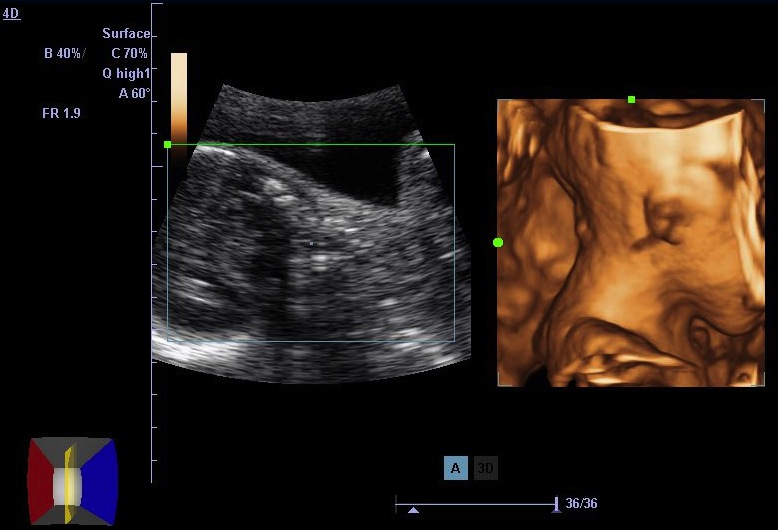
Everybody likes to see clear pictures of their baby, so it is important that a 4D scan is done at the right time. This is around 20-24 weeks of gestation, but a lot depends on the amount of liquor within the uterus. These pictures are from a pregnancy with excessive liquor, termed polyhydramnios, so the 4D scan pictures are particularly clear.
Semua ibu-bapa ingin melihat gambaran yang jelas kandungan mereka. Dari segi imbasan 4D, penting supaya ia dilakukan pada waktu yang betul, biasanya antara 20-24 minggu usia kandungan. Walaupun demikian, banyak bergantung pada jumlah air ketumban yang ada dalam rahim. Gambar-gambar ini diambil dari kandungan yang mengalami air ketumban yang berlebihan, lebih dikenali sebagai polyhydramnios, dan nyata kejelasan gambarnya.
Right thigh and knee/Peha dan lutut kanan


Wednesday, September 19, 2012

Funny Places for Endometriosis

The July edition of The Journal of Minimally Invasive Gynaecology (JMIG) presents 2 case reports of endometriosis occurring in abnormal places. In the first case, the patient had nose bleed and pain and was found to have growths there. The second case presented with gastric-like abdominal pain and was found to have a growth in the pancreas on scanning. Both cases were confirmed as endometriosis after surgical removal. Of note was that these patients had positive correlation with cyclical symptoms as well as previous suggestion of endometriosis. So, endometriosis in the nose and in the pancreas. Who would have thought it?
Tapak Aneh Penyakit Endometriosis 
Dalam isu bulan Julai The Journal of Minimally Invasive Gynaecology (JMIG), terpapar 2 kes penyakit endometriosis yang ditemui di kedudukan yang aneh. Pesakit kes pertama melapor pendarahan dan perasaan sakit di hidungnya serta ternampak ketumbuhan. Pesakit kes kedua pula mempunyai perasaan sakit ala gastrik dan ternampak ketumbuhan di kelenjar pankreasnya melalui imbasan. Kedua-dua kes ini dipastikan mengidap penaykit endometriosis selepas pembedahan untuk mengeluarkan ketumbuhan-ketumbuhan tersebut. Yang penting dalam kes-kes ini ialah sejarah perubatan yang mengaitkan penimbulan simptom-simptom tersebut dengan kitaran haid serta sejarah lama penyakit endometriosis. Jadi, endometriosis di hidung dan pankreas, sungguh aneh!

Wednesday, September 5, 2012

August Case - Twin Fibroids

Sorry, I have been meaning to write but have been swamped with other things. This was a 51 year old lady who had never conceived in 30 years and presented with abnormal and heavy menstrual bleeding. There was a mass felt in the abdomen, about 6 months pregnancy size. Ultrasound scan showed multiple uterine masses suggestive of fibroids. This was the view on laparoscopy - twin, large fibroids. I had counselled hysterectomy, but it was difficult due to the restricted view. I had to remove the fibroids from the uterus first (myomectomy) before proceeding to hysterectomy. As usual, everything was done laparoscopically. 
Fibroid Kembar
Maaf atas kelewatan menulis. Kes ini adalah seorang wanita berumur 51 tahun yang tidak pernah mengandung walaupun kahwin selama 30 tahun. Beliau mengalami pendarahan haid yang berpanjangan dan lebat, dan setelah diperiksa, didapati mempunyai ketulan di perut sebesar kandungan berusia 6 bulan. Imbasan ultrasound telah menampakkan banyak ketumbuhan di rahim yang berciri fibroid. Gambaran ini dilihat melalui laparoskop - fibroid-fibroid besar dan berkembar. Pembuangan rahim menjadi rumit apabila penglihatan terhad kerana ketumbuhan-ketumbuhan tersebut. Akhirnya, fibroid-fibroid ini dipisahkan dahulu dari rahim sebelum histerektomi dilaksanakan. Saperti biasa, semua prosedur dilakukan dengan melalui pembedahan laparoskopi.

Facts About Menopausal Hormonal Therapy


10 years after the seminal publication of the Women’s Health Initiative trials data1, certain facts and data have emerged that can help guide us in this so controversial an issue of Menopausal Hormonal Therapy (MHT). The following is a summary of a review published lately in the journal Menopause2.
It has always been a truth that MHT is an acceptable option for treating severe early menopausal symptoms. As is the wont of these symptoms, they disappear within 10 years of menopause, thus this treatment is prudent and applicable within this time frame. Such therapy must of course be precluded in the presence of medical problems, foremost of which are blood clots, heart disease, stroke and cancer.
Estrogen replacement alone suffices for a woman who has lost her uterus, whereas progesterone therapy needs to be added for the sole purpose of prevention of endometrial cancer in those who retain theirs. If the symptoms are limited to the vulva, vagina and the bladder, topical estrogen therapy to the affected parts might be enough to soothe the symptoms.
So much is so true, and we must keep in mind that the whole controversy arose not because of questionable beneficial effects, rather, the serious consequences of MHT. Foremost in the mind of most women is the occurrence of breast cancer. The WHI trials demonstrated an increased risk of breast cancer with more than 5 years continued use of the estrogen-progesterone combination therapy. This increased risk was not present in users of estrogen-only preparations, thus suggesting a causal link of breast cancer with progesterone. The data shows that the risk is not that great and decreases after discontinuation of said replacement therapy. Estrogen, whether given alone or together with progesterone, increases the risk of thromboembolic events (TE) such as deep vein thrombosis, pulmonary embolism and stroke, but these occurrences are rare before the age of 59 years.
Thus we have come to accept that combination estrogen-progesterone MHT is proven effective in the management of early menopausal symptoms only (and not for other indications) but should be used for the shortest duration and with the lowest possible dosage. More flexibility is accorded to estrogen only therapy but similar caveats should apply whenever possible.

Fakta Berkenaan Rawatan Hormon Menopause
10 tahun selepas maklumat daripada kajian unggul berkenaan rawatan menopause diketengahkan1, situasi berkenaan rawatan ini semakin jelas, saperti dipaparkan dalam jurnal Menopause baru-baru ini2. Berikut adalah ringkasan tajuk utama.
Terapi hormon untuk menopause (MHT) sungguh berkesan mengatasi gejala awal menopause dan boleh diteruskan selama 10 tahun, iaitu, sehingga simptom-simptom keadaan ini hilang. Rawatan ini tidak boleh digunakan jikalau seseorang wanita mengalami beberapa masalah perubatan, terutama sekali ketulan dalam saluran darah, serangan angina ahmar, sakit jantung dan kanser.
Rawatan ini boleh dibahagikan kepada 3 – hormon estrogen sahaja untuk wanita yang tidak mempunyai rahim, kombinasi hormon estrogen-progesteron bagi mereka yang ada rahim dan krim estrogen setempat jikalau gangguan terhad kepada kemaluan, faraj atau pundi kencing.
Risiko penggunaan MHT ialah kejadian saperti kanser payudara dan kejadian tromboembolik (TE) saperti angina ahmar, ketulan darah dan embolasi paru-paru. Tidak dinafikan yang MHT meningkatkan risiko mengalami kanser payudara, tetapi jumlah kejadian ini kecil dan risiko tersebut hilang selepas rawatan diberhentikan. Lagipun, risiko berlakunya kanser payudara hanya meningkat jika digunakan terapi kombinasi estrogen-progesteron dan bukan estrogen bersendirian. Kejadian TE lebih berkemungkinan berlaku dengan kesemua jenis rawatan oral tetapi jarang dialami sebelum umur 59 tahun.
Dengan ini, MHT didapati sesuai untuk rawatan simptom-simptom awal menopause sahaja tetapi perlu digunakan dalam dos yang paling rendah dan dalam jangkamasa yang paling pendek. Pengawasan untuk gejala kanser payudara dan kejadian TE mesti berterusan.


1. Risks and Benefits of Estrogen Plus Progestin in Healthy Postmenopausal Women. Principal Results From the Women's Health Initiative Randomized Controlled Trial. JAMA 2002;288(3):321-333.
2. Stuenkel CA, Gass MLS, Manson J et al. A Decade After the Women’s Health    Initiative – The Experts Do Agree. Menopause 2012;19(8):846-847.

Sunday, August 5, 2012

Increased Risk of Type 2 Diabetes With Polycystic Ovary Syndrome


Peningkatan risiko mengidap penyakit kencing manis untuk wanita PCOS

It has been known for some time that a woman with PCOS has an increased risk of getting Diabetes mellitus (DM) has been known for some time. Adding to this knowledge is a new study from Cardiff that examined a very large number of patients (more than 20000) to confirm this point. The data taken from the UK's General Practice Research Database showed a 2-3-fold increase of DM among PCOS women when compared with controls.

Telah lama diketahui bahawa seseorang wanita yang mengalami PCOS berisiko lebih tinggi mengidap penyakit kencing manis (DM). Kini, kenyataan ini menjadi lebih kukuh berdasarkan satu kajian dari Cardiff, United Kingdom yang melibatkan lebih dari 20 000 orang wanita. Maklumat daripada kajian ini mendapati wanita PCOS berkemungkinan mengidapi DM 2-3 kali ganda lebih berbanding dengan wanita tanpa PCOS.

Christopher L. Morgan, Sara Jenkins-Jones, Craig J. Currie, and D. Aled Rees. Evaluation of Adverse Outcome in Young Women with Polycystic Ovary Syndrome Versus Matched, Reference Controls: A Retrospective, Observational Study. JCEM jc.2012-1690; doi:10.1210/jc.2012-1690